

Materials User Guide (with Financials)
Table of Contents
- Overview
- Considerations
- Project Setup
- Process Diagrams
- Create Requirements (Optional)
- Ordering
- Receiving
- Issue Materials
- Invoicing
- Resolve Defects
- Create a Transfer
- View and Adjust Inventory
Overview
Considerations
Project Setup
Process Diagrams
-
Order and Receive with Commitments
-
Manage Defects
Order and Receive with Commitments

Manage Defects

Create Materials Requirements
Overview
Create a Purchase Order
Background
Things to Consider
- Required User Permissions:
- To create a purchase order and see/enter data on the Schedule of Values (SOV) tab:
- 'Admin' level permissions on the project's Commitments tool.
OR - 'Standard' level permissions on the project's Commitments tool and the 'Allow Users to See SOV Items' setting must be enabled and your name must be selected in the 'Select a Person' drop-down list.
- 'Admin' level permissions on the project's Commitments tool.
- To create a purchase order and see/enter data on the Schedule of Values (SOV) tab:
-
For companies using the
 ERP Integrations tool: Prerequisites, requirements, limitations, and considerations might apply depending on the ERP system your Procore account is integrated with. Visit Things to Know about your ERP Integration for details.
Prerequisites
Steps
- Navigate to the project's Commitments tool.
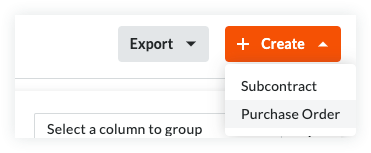
- On the Contracts tab, click the Create button and choose Purchase Order from the drop-down list.
Note
- The Create button is available when you are viewing the Contracts and Recycle Bin tabs. New purchase orders are always added to the Contracts tab.
- The Export button is only available on the Contracts tab. To learn more, see Export a Commitments List.
- Continue with the next steps:
Add the Basic Information
Update the basic information as follows:

Notes
- There are no required fields when adding the basic information.
- If you click the Create button without completing any data entry, Procore saves the contract, lists you as the creator, and automatically places it in the Draft status.
- Contract Number
To number your contract(s), choose from these options:- If you number your contracts using a sequential numbering system, you can enter any combination of alpha-numeric characters in this box. For subsequent contracts, Procore automatically applies consecutive numbering in ascending order.
Example
The examples below show you how Procore's ascending consecutive numbering works:
- If the previous contract was 1, the next contracts are 2, 3, and so on.
- If the previous contract was PC-0001, the next contracts are PC-0002, PC-0003, and so on.
- If the previous contract was DCA00010-12-G-0001, the next contracts are DCA00010-12-G-0002, DCA00010-12-G-0003, and so on.
- If you do NOT number your contracts using sequential numbering, you can manually enter a unique number for each purchase order. To do this, type over the existing entry in the Number box. Duplicate contract numbers are NOT permitted.
Notes
- For companies using the ERP Integrations tool, your integrated ERP system may impose a maximum character limit. See What is the maximum character length for a commitment's 'Number (#)'? Important! When a commitment is exported to Integration by Ryvit, it must have a unique number.
- You can customize the numbering scheme for your project's commitments. To learn more, see Can I customize the numbering system for financial objects in Procore?
- If you number your contracts using a sequential numbering system, you can enter any combination of alpha-numeric characters in this box. For subsequent contracts, Procore automatically applies consecutive numbering in ascending order.
- Contract Company
Select the company responsible for fulfilling the Purchase Order (for example, American Construction Co.).
Notes:- To appear in this list as a selection, add the company to the Project Directory. For details, see Add a Company to the Project Directory or Import Users & Vendors into your Project Level Directory Tool (Procore Imports).
- Title
Type a descriptive name for the contract.Notes
- If your company has enabled the ERP Integrations tool, be aware that some integrated ERP systems impose character limits on the 'Title' field when data exported from Procore is imported into their system.
- For details about character limits, see What is the maximum character length for a commitment's 'Title'?
- Optional: Sign with DocuSign®
Move this toggle to the right to collect signatures with the Procore + DocuSign® integration. To learn how to activate the integration in Procore, see Enable or Disable the DocuSign® Integration on a Procore Project.
Update the General Information
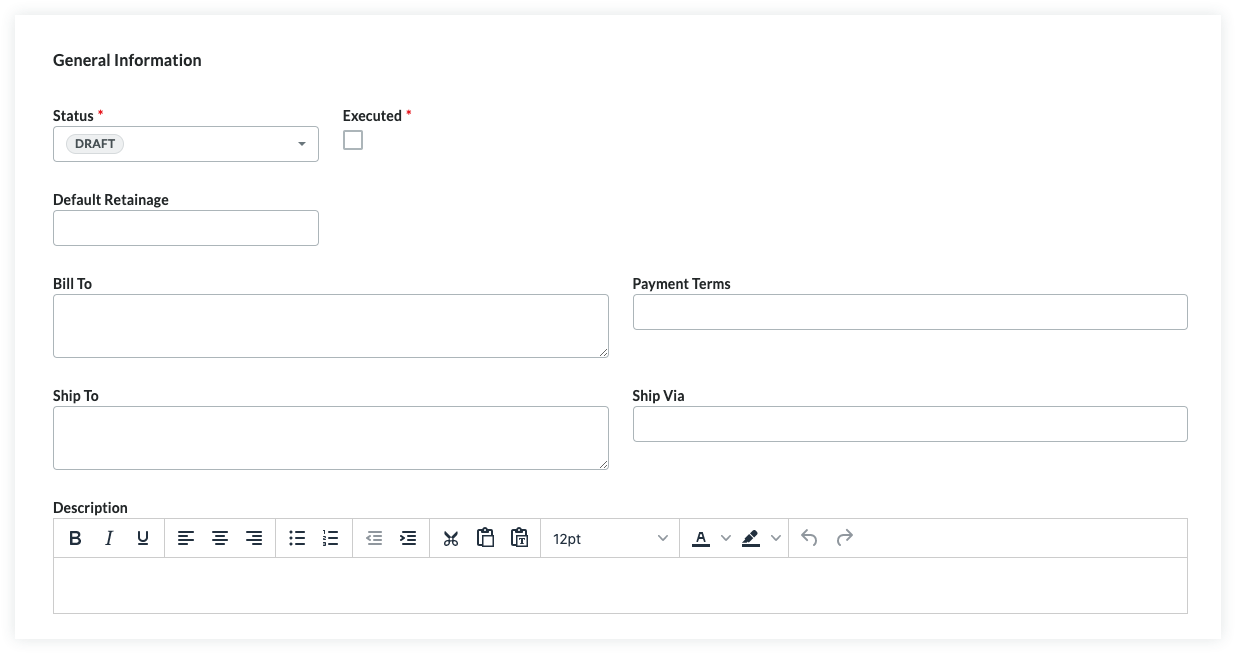
Update the contract with more general information:
- Status
Procore automatically assigns contracts the 'Default' status. To select a different status, choose one of the status labels from the drop-down list. Options includeNote
To create change orders and invoices, your contract's status must be set to Approved or Complete. - Executed
Place a mark in this check box if the contract has been fully executed. A fully executed contract is a legally effective agreement that has been signed by authorized representatives for each party.Notes
- Many Procore users choose to place a checkmark in the 'Executed' box when placing the purchase order into the 'Approved' or 'Complete' status.
- The time at which your project team places a checkmark in the 'Executed' box should always be aligned with your project's unique business process
- Default Retainage
Enter a number to represent the percentage that will be withheld as retainage on the line items of the contract's Schedule of Values. For example, if you plan to withhold ten (10) percent of the line item's value, enter 10%.Notes
- The 'Default Retainage' amount set on the purchase order will only affect the amount on the first invoice. Editing this value after creating the first subcontractor invoice will NOT affect the retainage amount on subsequent invoices.
- In order to set or release the retainage amount on a subsequent invoice, complete the steps in Enable Retainage on a Purchase Order or Subcontract. Next, use one of these Procore tools to set or release retainage on the invoice:
- Commitments. Set or Release Retainage on a Subcontractor Invoice.
- Invoicing. Set or Release Retainage on a Subcontractor Invoice. If you would like to set up retention rules that automatically adjust withheld amounts on your subcontractor invoices, see Enable Sliding Scale Retention Rules on on a Commitment's Invoices.
- Bill To
Enter the business contact information for the party paying for the order. Procore uses this information to auto-populate the 'Bill To' address on any invoices created for this order. - Assigned To
Enter the name of the individual assigned to the Purchase Order. - Payment Terms
Enter the payment terms. For example, Net 30, Net 45, and so on. - Ship To
Enter the business contact information for the shipping destination. Procore uses this information to auto-populate the 'Ship To' address on any invoices created for this order. Keep in mind this address may be different from the 'Bill To' address. For example, you may choose to have the order delivered directly to the job site or to an off-site staging location. - Ship Via
Enter the shipping method for the order. For example, Air, International, Ocean, Truckload, Train, and so on.Note
The 'Ship Via' field is a free-form text field, so you can enter the appropriate shipping method, carrier, and/or tracking number for the order. - Description
Enter a more detailed description of the prime contract. You can apply the options in the formatting toolbar to your text.
Update the Contract Privacy
Using the privacy setting allows only project admins and the select non-admin users access. To change the contract's access permissions, do the following:
- Check or Uncheck the 'Private' box. Procore turns this setting ON by default.
- Select an employee of the 'Contract Company' from the Invoice Contact drop-down list.
Update the Contract Dates
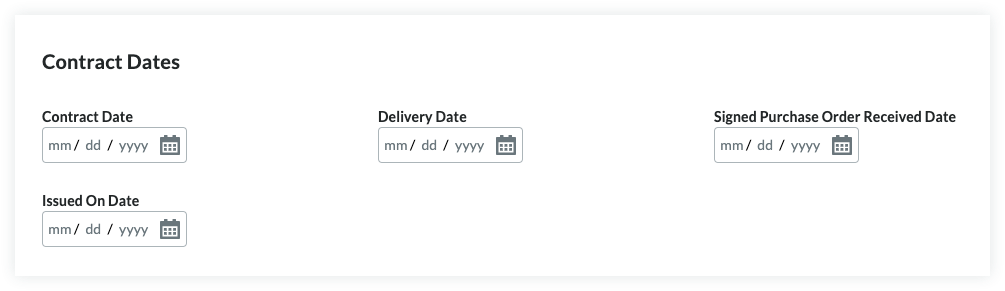
To update the contract with important dates, do the following:
Notes
- Your company's Procore Administrator manages the dates that appear in the 'Contract Dates' section using the configurable fieldsets feature.
- For details, see Which fields in the Commitments tool can be configured as required, optional, or hidden?
- Signed Purchase Order Received
Select the date the executed purchase order was received. - Contract
Select the contract date for the order. - Delivery
Select the expected or actual delivery date for the order. - Issued On
Select the date the order was issued by your company.
Update the Schedule of Values
There are two (2) method for updating the purchase order's SOV:
- Add Line Items to the Schedule of Values
- Import Line Items to the Schedule of Values from a CSV File
Add Line Items to the Schedule of Values
By default, you can input line items on the purchase order's SOV at any time, as long as it is NOT in the 'Approved' status.
Note
If your project team has turned the 'Enable Always Editable Schedule of Values' configuration setting ON in this tool, users with the required user permission to Edit Purchase Orders can add line items to the Schedule of Values when a purchase order is in any status. To learn specific information this setting, see What is the 'Enable Always Editable Schedule of Values' setting?To manually add line items to the Schedule of Values:
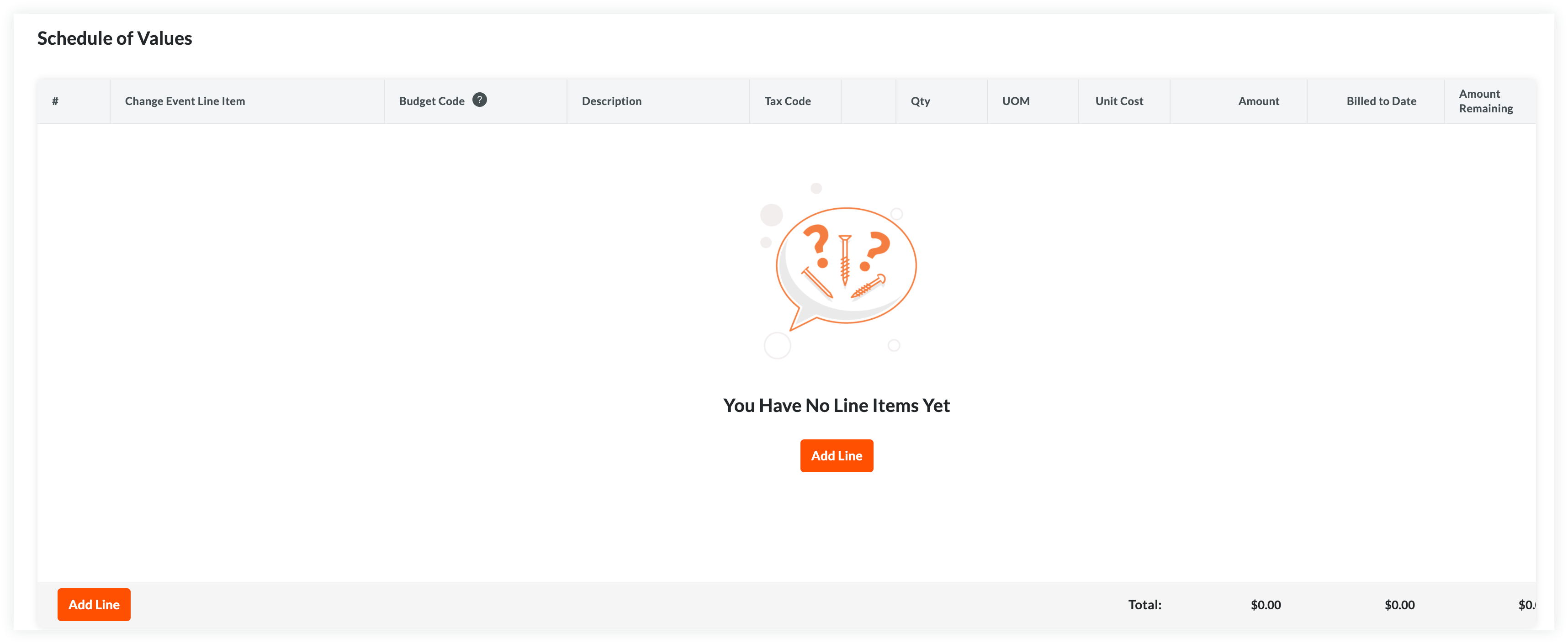
- Choose from these options:
- If the SOV is blank, click Add Line under 'You Have No Line Items Yet'.
OR - If you have existing line items, click Add Line.
Procore creates new line items starting with the number '1'. Subsequent lines are created in numerical order.
- If the SOV is blank, click Add Line under 'You Have No Line Items Yet'.
- Designate a budget code for the new line item. You have these options:
- To assign an existing budget code to the line item, start typing a code in the Search box and select the matching code from the list.
OR - To create a new budget code for the line item, click the Create Budget Code button. Next, select the appropriate segment items from the drop-down list(s) to satisfy your project's budget code pattern requirements. Then, click Create.
- To assign an existing budget code to the line item, start typing a code in the Search box and select the matching code from the list.
- Depending on the accounting method you are using, choose the appropriate steps for adding a line item:
- For an Amount-Based contract:
An Amount-Based SOV requires this data entry:- #
Procore automatically enters a line item number in sequential order. - Change Event Line Item
If you have change events enabled, you can select a change event line item if the commitment needs to be linked to a change event. - Budget Code
Select a budget code from the list or click Create Budget Code to create a new one. See What is a budget code in Procore's WBS? - Description
Enter a description for the line item. For example, type: Monthly Service Fee - Amount
Enter the amount of the cost. - Billed to Date
The system automatically calculates the amount billed on the commitment up to the current date. - Amount Remaining
Enter the amount that has NOT been billed to the current date. - Tax Code
Enter a tax code to use for this line item. This field only appears if you have enabled the tax codes feature. See How can I use tax codes on a project?
- #
- For a Unit/Quantity Based contract:
A Unit/Quantity Based SOV requires this data entry:- #
Procore automatically enters a line item number in sequential order. - Change Event Line Item
If you have change events enabled, you can select a change event line item if the commitment needs to be linked to a change event. - Budget Code
Select a budget code from the list or click Create Budget Code to create a new one. See What is a budget code in Procore's WBS? - Description
Enter a description for the line item. For example, type: Monthly Service Fee - Qty
Enter the number of units. - UOM
Enter the Unit of Measure (UOM).Note
- To view the default options in the list, see Which units of measure are included on Procore's master list?
- To update the available options in the list, see Update a Unit of Measure to the Unit of Measure Master List.
- Unit Cost
Enter the Unit Cost in the box provided. - Amount
The system automatically calculates the subtotal for you, based on the Qty, UOM, and Unit Cost entries. - Billed to Date
The system automatically calculates the amount billed on the commitment up to the current date. - Amount Remaining
Enter the amount that has NOT been billed to the current date. - Tax Code
Enter a tax code to use for this line item. This field only appears if you have enabled the tax codes feature. See How can I use tax codes on a project?
- #
- For an Amount-Based contract:
- Optional: Repeat the steps above to add as many line items as needed.
- Click Save.
Procore saves the line items on the contract's SOV.
Import Line Items to the Schedule of Values from a CSV File
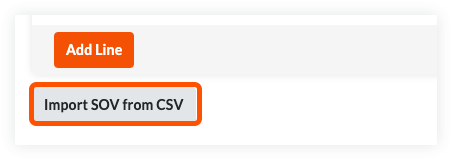
- In the 'Schedule of Values' card, click the Import SOV from CSV button.
- Click the Download CSV Template button and choose one of these options:
- Blank Template. Click this option to download a blank template.
OR - Template with Existing Line Items. Click this option to download a template that includes any existing line item data from your project's budget.
Note
- Procore downloads a CSV template file to your web browser's file download location.
- The name of the file is: TBD
- Blank Template. Click this option to download a blank template.
- Open the template that you downloaded on your computer.
- Enter the data that you want to upload directly into the template.
Important
Do NOT change or rearrange the Column Headings in the template file. - After entering your line item data, make sure to save your file updates in the 'Comma Separated Values' file format.
- Navigate back to Procore. Then, in the 'CSV File' section, choose one of these options:
- Click Upload File.
OR - Use a drag-and-drop operation to move the template you just updated into the 'CSV File' section.
- Click Upload File.
- Choose one of these options:
- Add Additional Line Items. Choose this option if you want to create new line items using the data in your template.
OR - Replace Existing Line Items. Choose this option if you want to erase any existing line items from the prime contract and replace them with data in your template.
Note
If the 'Enable Always Editable Schedule of Values' configuration setting is turned ON in the project's Commitments tool, the 'Replace Existing Line Items' option is grayed out and unavailable for use once an invoice is created and line items are billed. To learn more, see What is the 'Enable Always Editable Schedule of Values' setting?
- Add Additional Line Items. Choose this option if you want to create new line items using the data in your template.
- Click Import.
Attach Files
To add file attachments to the contract:
- On the 'Attachments' card, click Edit.
- Click Attach Files.
- In the 'Attach Files' dialog box, highlight the location where the files to upload are stored. Options include:
- My Computer. Click Upload Files to open your computer's finder. Select the files to upload and click Open.
- Photos. If the Photos tool is active on the project, choose the location from the Select Album list and then search for the file(s) to upload.
- Drawings. If the Drawings tool is active on the project, choose the area from the Select Area list and then search for the file(s) to upload.
- Forms. If the Forms tool is active on the project, choose the template from the Select Template list and then search for the file(s) to upload.
- Documents. If the Documents tool is active on the project, navigate to the folder storing the file(s) to upload and then highlight them.
- Click Attach.
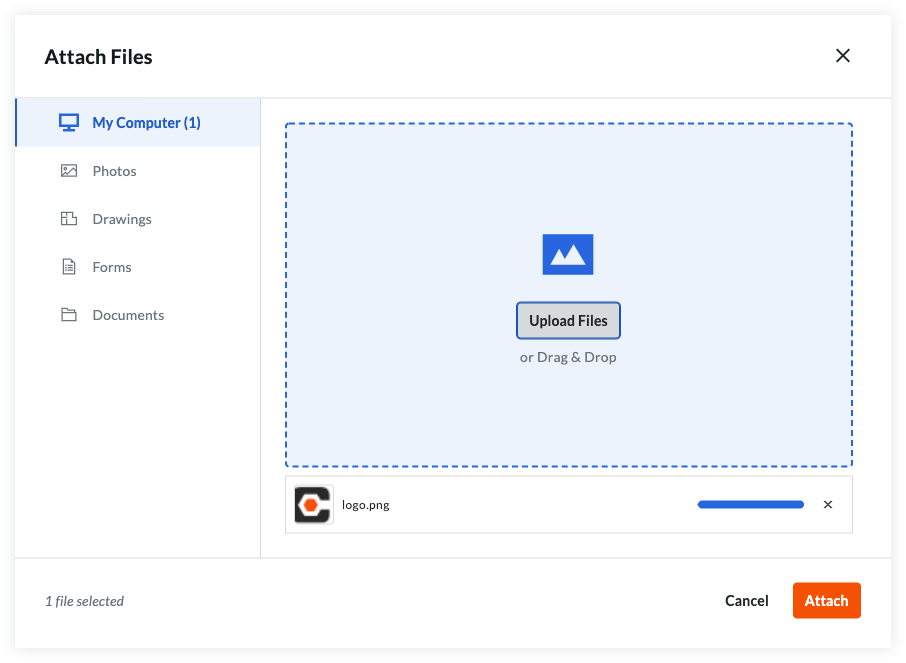
A progress indicator shows you the status of the upload. - Click the Close (X) icon on the Attach Files dialog box.
Save the Contract
To save the contract, click one (1) of these buttons:
- Create. Click this button to save the new contract and return to the 'General' tab in view mode.
OR - Complete with DocuSign®. Click this button to launch the Procore + DocuSign® integration and prepare the envelope for signature. To learn more, see DocuSign®.
OR - Cancel.
Next Steps
If your company has enabled the ERP Integrations tool:
Create a Change Order (CCO)
Objective
To create a commitment change order.
Background
In Procore, purchase orders and subcontracts are called commitments. A commitment is a contractual agreement between a buyer (for example, a project owner, a general contractor, or a specialty contractor) and a seller (for example, a contractor, a subcontractor, or a vendor). The seller is responsible for completing project work or fulfilling an order for the buyer. When you need to alter the terms of the original agreement, you can create a commitment change order.
Important
When the Change Events tool is enabled on a project
The process that you will use to create a commitment change order in Procore depends upon a few factors. First, if the Change Events tool is disabled on the project, you will use one of the processes below. Also, keep in mind that the number of steps required to create a commitment change order is dependent upon the change order tier setting that is configured on the project's Commitments tool. See Configure the Number of Commitment Change Order Tiers:
- 1-Tier configuration:
- Create a commitment change order as described below.
- 2-Tier configuration
- Create a commitment potential change order
- Create a commitment change order
PROCORE INTERNAL USE ONLY
Although not recommended, Procore also supports a 3-Tier configuration:
- 3-Tier configuration
- Create a commitment potential change order
- Create a change order request
- Create a commitment change order
Things to Consider
- Required User Permissions:
- 'Admin' level permissions on the project's Commitments tool
- 'Admin' level permissions on the project's Commitments tool
- Additional Information:
- If the Change Events tool is disabled on the project:
- The steps for creating a change order are determined by the number of change order tiers configured for the Commitments tool. See What are the different change order tier settings in Project Financials? and Configure the Number of Change Order Tiers.
- If the Change Events tool is enabled on the project:
- The Create Commitment CO button is not available.
- Instead, click Create Change Event.
- Next, follow the steps in Create a Change Event.
- Then, follow the steps in Create a Commitment Change Order from a Change Event.
- If the Change Events tool is disabled on the project:
- For companies using the ERP Integrations tool: Show/Hide
- Additional requirements, considerations, and limitations vary depending on the ERP system your company's account is integrated with. Most ERP systems have limitations on the number of characters that can be used for a commitment's title. See Things to Know About your ERP Integration for details.
Prerequisites
Steps
Create a Commitment Change Order
If you have created a purchase order or a subcontract and need to alter the terms of that item, use the steps below to create a commitment change order.
- Navigate to the project's Commitments tool.
- Under Contracts, locate the commitment. Then click Edit.
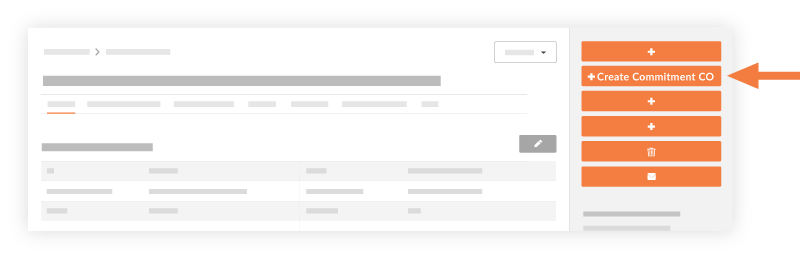
- Click Create Commitment CO.
Notes
If the Change Events tool is enabled on your project, the Create Commitment CO button is not available. Follow these steps instead:
- First, click Create Change Event.
- Next, follow the steps in Create a Change Event.
- Then, follow the steps in Create a Commitment Change Order from a Change Event.
- In the General tab, do the following:
- Sign with DocuSign®
If you have enabled the Procore + DocuSign® integration (see Enable or Disable the DocuSign® Integration on a Procore Project), a checkmark appears in this box by default. If you do NOT want to collect signatures with DocuSign®, remove the mark. - Number
This field automatically populates based on the number of change orders already created. By default, the number will automatically increment by one.Tip
How does Procore assign numbers to commitment change orders? To learn more, see Can I customize the numbering system for financial objects in Procore? - Revision
- Displays the change order's revision number. When a change order is first created, its revision number is zero. A change order could have multiple revisions because of feedback from a reviewer/approver.
- Date Created
Automatically populates with the date that you create the commitment change order. The date cannot be changed. - Created By
Automatically populates with the name of the user who is creating the change order. - Contract Company
Automatically populates with the name of the subcontractor or vendor listed on the subcontract. This field is only available for subcontracts. - Contract
Automatically populates with the name of the contract for which the change order is being created. This field is only available for subcontracts. - Title
Enter a name for the change order. The maximum character limit is 255 characters.Important
If you are using an integrated ERP system, the maximum character limit for the 'Title' field on a commitment is different for each system. For a list of each system and its limitation, see What is the maximum character length for a commitment's 'Title'? - Status
Select a status for the change order. To learn more, see What are the default statuses for change orders in Procore? - Private
Mark this checkbox to make the change order visible only to users with 'Admin' level permissions on the Commitments tool. - Change Reason
Select one of these reasons for the potential change order: Client Request, Design Development, Allowance, Existing Condition, or Backcharge. To learn how to configure change reasons, see Set Default Change Management Configurations. - Accounting Method
This field inherits the accounting method that was specified in the contract. - Due Date
Select a due date for when the change order must be approved by. - Invoiced Date
Select the date when the change order was invoiced. - Designated Reviewer
Select the Procore project user at your organization who will be responsible for approving or rejecting this change order later. See Approve or Reject Commitment Change Orders.Important
- The 'Designated Reviewer' can submit an approve or reject response only when a change order is in the Pending - In Review status.
- To send an email notification to the 'Designated Reviewer' to notify that person that a change order is awaiting their response, you have these options:
- You can forward the prime contract change order to the 'Designated Reviewer' by email. See Forward a Change Order to a Project User by Email.
OR - The pending change order will also be listed in the 'My Open Items' area in the project's Home page. The user can check this page at any time.
- You can forward the prime contract change order to the 'Designated Reviewer' by email. See Forward a Change Order to a Project User by Email.
- After the 'Designated Reviewer' submits an approve or reject response, the 'Reviewer' field (directly below the 'Designated Reviewer' field) shows the date/time stamp of that users response. The 'Reviewer' field is only visible to the 'Designated Reviewer.'
- Request Received From
Select a user from the project's directory who you are submitting the change order on the behalf of. - Description
Enter a detailed description of the change order.Notes
- If you are exporting the change order to Sage 300 CRE® and Integration by Procore, entries exceeding one thousand (1000) characters will be truncated during the export.
- If you will be exporting the change order to a different integrated ERP system, you can to enter an unlimited number of characters in Procore.
- Schedule Impact
If known, you can provide an estimate of the number of additional days that would potentially be added to the current project schedule if the change order were approved. - Location
Use the location drop-down menu to select a location the [item] impacts. Either select from the predefined locations, or add a multi-tiered location. See Add a Multi-tiered Location to an Item. This location may be as general as the site location at the first tier or as specific as where on the site the contractor will be working at the second tier. - Reference
Reference any other tools, materials or documents that are related to the change order. - Executed
Mark this check box if the change order has already been executed. - Field Change
Mark this check box if the change order requires a field change. - Paid in Full
Mark this check box if the cost is already covered in the budget. - Attachments
Select and add any relevant documents.
- Sign with DocuSign®
- Click Create or Create & Email to send the change order to any users listed as 'Reviewers'.
Add a Schedule of Values (SOV) to the Change Order
If there are costs associated with the change order, add line items to the change order's Schedule of Values (SOV). 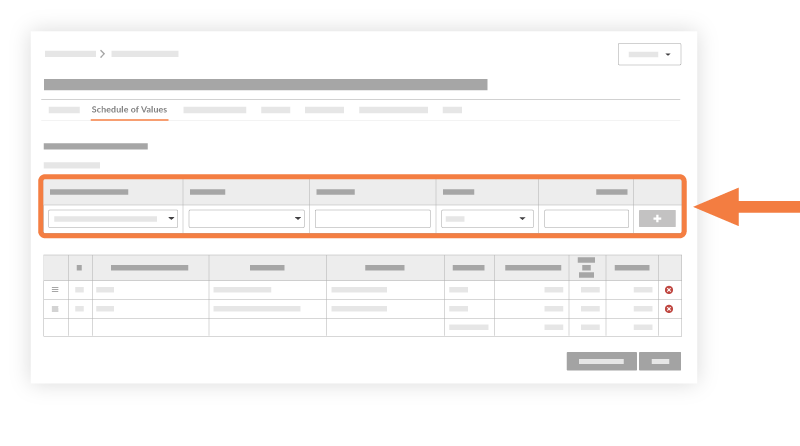
- Click the Schedule of Values tab.
- Click Edit.
- Click Add Line.
- Prime Contract Line Item
Select a line item from the drop-down list. If there is no line item that fits, select Not Budgeted. - Change Event Line Item
Select a change event line item from the drop-down list. - Sub Jobs
If the Sub Jobs feature is enabled on your project, select one from the list. See Enable Sub Jobs on Projects for WBS. - Budget Code
Select a budget code from the drop-down list. See What is a budget code in Procore's WBS? - Description
Type a description for the new change order. - Cost Amount
Enter an amount in the box. - Optional: Tax Codes
If you are using tax codes with this project, select a tax code to use for the line item.Tip
Don't see the Tax Codes field? This field only appears when the tax codes feature is enabled on the Procore project. See How can I use tax codes on a project?
- Prime Contract Line Item
- Click Add
- Repeat these steps for each line item.
- Click Save.
Note
For Companies That Have Enabled the ERP Integrations Tool
After the commitment change order is placed into the 'Approved' status in the Commitments tool, project managers will typically send the change order to the ERP Integrations tool where it must be accepted by an accounting approver for export to the integrated ERP system. For instructions, see Send a CCO to ERP Integrations for Accounting Acceptance.
Next Steps
Overview
Create a Shipment
Background
You can use Procore to manage materials for your project. From the Materials tool, you can create shipments to track the materials you have ordered. You can create shipments for orders you placed outside of Procore, or from approved commitment change orders or purchase orders made in Procore's Commitments tool.
Things to Consider
-
Once submitted, you can only add files, notes, or custom fields to your shipment.
-
Submitted shipments cannot be deleted.
Prerequisites
-
Materials must be listed in your inventory using one of the following methods:
-
The Commitments tool was used to create a commitment change order or purchase order for materials, and includes the following information:
-
The status is Approved
-
The Schedule of Values (SOV) includes the following for each line item:
-
Description
-
Unit of Measure (UOM)
-
-
Steps
-
Navigate to the project's Materials tool.
-
Click Create and select Shipment.
-
-
Add Items to Include in the Shipment.
-
Click Add All Order Items to include all items from the associated purchase order.
-
Click the search bar to add items from the associated purchase order. If no purchase order has been associated with the shipment, you can add any ordered material to the shipment.
-
Optional: Click the delete
 icon to delete the line item.
-
-
Save or submit the receipt.
-
Click back to the Materials main menu to save the receipt as a Draft.
-
Click Submit to finalize the shipment.
Note: You can only attach files, add notes, or add custom fields to submitted shipments. Submitted shipments cannot be deleted.
-
Next Steps
Create a Receipt
Background
You can use Procore to manage materials for your project. From the Materials tool, you can create receipts to track the materials you have received, and any defects. You can create receipts for orders placed outside of Procore, or approved commitment change or purchase orders made in Procore's Commitments tool.
Things to Consider
-
If you selected an Associated Purchase Order, line items are filtered to the purchase order.
-
If you selected an Associated Shipment, you can only add the items in the shipment, not the entire purchase order.
-
When splitting line items, the item quantities will always equal the total quantity received.
-
Defect Creation
-
Defects are automatically created when a receipt is Finalized.
-
If the quantity received is less than the the quantity expected, a Short defect is created.
-
If the quantity received is more than the quantity expected, an Overage defect is created.
-
If the condition for items marked as Damaged or Unacceptable a defect is created.
-
Prerequisites
-
Locations must already be created in Procore. See Add Locations to a Project.
-
Materials must be listed in your inventory using one of the following methods:
-
The Commitments tool was used to create a commitment change order or purchase order for materials, and includes the following information:
-
The status is Approved
-
The Schedule of Values (SOV) includes the following for each line item:
-
Description
-
Unit of Measure (UOM)
-
-
Steps
-
Navigate to the project's Materials tool.
-
Click Create and select Receipt.
-
Enter the Date Received.
-
-
Enter the line item information. Show/Hide Fields
-
Add Line Items
-
Click Add All Order Items to include all items from the associated purchase order.
Note: If you select an Associated Shipment, this option is not available. Instead, you may only add the items in the shipment. -
Click Add All Shipment Items to include all items from the associated shipment.
-
Click the search bar to add items from the associated purchase order or shipment.
Note: If no purchase order or shipment has been associated with the receipt, you can add any ordered material to the receipt. However, it will not update remaining quantities for any orders or shipments.
-
-
Optional: Click the delete
icon to delete the line item. -
Enter the Quantity Expected.
Note: If there is an associated purchase order, this field is automatically set to the quantity left to receive. -
Enter Quantity Received.
-
Update the Condition and Storage Location.
-
Click the condition field for the item and select its condition.
-
Acceptable
-
Damaged
-
Unacceptable
-
-
Click the storage location for the item and select a new location.
-
Line items are automatically saved. If needed, click Close.
Splitting Line Items for Condition or Location
You can split line items, either to indicate some of the received quantities are not in acceptable condition, or to allocate quantities to different storage locations.
- In the line item's row, next to the storage location, click the add
 icon.
icon. - Enter the Condition of the items.
- Enter the Quantity of those items.
- Enter the Storage Location for those items.
- In the line item's row, next to the storage location, click the add
-
-
-
Save or submit the receipt.
-
Click Save as Draft to save the receipt as a draft.
-
Click Submit to submit the receipt for approval.
-
Next Steps
Review and Finalize Receipts
Issue Materials
Invoicing
Resolve Defects
Create a Transfer
View Inventory
Steps
-
Navigate to the project's Materials tool.
-
Click the Inventory tab.
-
View Materials.
-
View by Item or Location

-
Click Items to see a total for each unique item.
-
Click Locations to see materials broken out by the location.
-
-
View Quantities (available in 'Items' view)
-
Quantity Required. How much material is currently required, based on 'Final' Requirements documents.
-
Quantity Ordered. How much has been ordered using the Commitments tool.
-
Quantity Received. How much has been received using receipts.
-
Quantity Issued. How much has been issued for use.
Note: Issuing functionality is not yet available in the open beta. -
Quantity Available. How much has been received, but not yet issued.
-
-
Create an Adjustment
Background
If the 'Available' inventory quantities in the Materials tool are inaccurate, you can make a manual correction by creating an adjustment.
Alternatively, if you imported materials, you can create an adjustment to add available quantities to the materials you imported.
Available quantities are updated when adjustments are finalized.
Things to Consider
-
You can have multiple line items with different kinds of adjustments in a single adjustment.
-
Adjustment Type controls whether quantities are added or subtracted from inventory.
-
Adjustment Reason will eventually be available in reporting.
-
Item Condition
-
'Acceptable' Materials
-
Are added or removed from the 'Quantity Available' in your inventory when the adjustment is finalized.
-
You can only remove items with an 'Acceptable' condition, even if the item's Adjustment Reason is 'Damaged' or 'Unacceptable'.
-
-
'Damaged' and 'Unacceptable' Materials
-
If you add 'Damaged' or 'Unacceptable' materials, the quantities are not added to the 'Quantity Available' count.
-
-
Prerequisites
-
Materials must be listed in your inventory by one of the following methods:
-
On an active project, the Commitments tool was used to create a commitment change order or purchase order for materials, and includes the following information:
-
The status is Approved
-
The Schedule of Values (SOV) includes the following for each line item:
-
Description
-
Unit of Measure (UOM)
-
-
-
You must be in the Items view.
Steps
-
Navigate to the project's Materials tool.
-
Click the Inventory tab.
-
Mark the checkboxes of the materials you want to adjust.
-
Click Add to New Document and select Create Adjustment.
-
Enter the general adjustment information.
-
Enter the adjustment for each line item.
-
Save or submit the adjustment.
-
Click Save as Draft to save the adjustment as a draft.
-
Click Submit to submit the adjustment for approval.
-
Next Steps