07 Thermal and Moisture Protection
ROOFING - SCOPE ITEMS
- Verify that designed system, all components, conforms to project design pressures.
- Review lightweight insulating concrete versus tapered. Lightweight is more cost effective, but will require a greater thickness, review roof for areas where LWIC thickness could be an issue.
- Verify warranty requirements, and submit for approval with initial submittals.
- Verify that subcontractor warranty includes the penetrations.
- Verify that system/membrane specified can obtain the warranty specified.
- Most Owners and Architects don’t realize that the manufacturer’s warranty is void if winds exceed 72mph (which is a tropical storm). A wind rider is available for additional cost, and additional requirements will be levied by the manufacturer. This must be initiated prior to shop drawings in order to involve the manufacturer. Submit warranty with submittals for approval by all parties.
- Buy full 3-year labor and material warranty from roofing subcontractor on condo projects. This is in addition to manufacturer’s extended warranty.
- Most manufacturer warranties are void if the roof is exposed to wind speeds greater than a certain miles per hour. This varies by manufacturer, but a good rule is 72mph is the threshold for modified systems and 55mph for TPO membranes.
- A wind rider can be purchased by the Owner to increase the wind speeds mentioned above. The cost and requirements will vary depending on the desired wind speed and the manufacturer. Discuss this with ownership, especially if they intend on holding the asset for the long term.
- Coordinate the number and type of M.E.P. penetrations with M.E.P. trades. All roofers will get this number wrong in their base bid.
- For a project with split systems, roof mounted CU’s on stands, the number of penetrations will average 3.5 per CU for stand leg, plus one for each CU for electrical penetration. Verify if fans are stand mounted, or on curbs.
- Include duct support and refrigerant line stands as well (may not be shown on mechanical plan)
- Perform take-off for LF of curb at RTU’s, fans, etc.
- Include penetrations for vent piping, roof manifolds, etc.
- Include an allowance for additional penetrations in subcontract if possible and establish unit rate for each vertical penetration (should be around $45 to $55 each) and LF of curb flashing
- Detailed and site specific flashing details shall be included in submittal package.
- If back of mansard is specified as stucco, discuss possibility of high wall flashing with roofing subcontractor. Include in roof warranty.
- Preferred method is roofing material up and over backside of mansard/parapet with metal coping cap or gravel stop flashing.
- Are lightweight tests (pull test and compression) performed by sub or 3rd party?
- Identify scupper openings, and expansion joint details and include in roofer scope accordingly.
- During buy, discuss possibility of setting of condensing units on stands to prevent roof damage from go back work.
- Buy installation of tile roof first, then installation of flat roof, if applicable, to prevent tile roof installation from damaging flat roof.
- Verify if roof insulation value is minimum or average. Compare with energy calculations.
- Preferred method of tile roof installation is foam set vs mechanical fastener to minimize penetrations.
- Specify hurricane tie down of loaded roof tile in scope.
- Verify quantity and location of walk pads. Confirm path meets egress requirements.
ROOFING - FIELD & QC ITEMS
- Obtain roof shop drawing as quickly as possible to coordinate heights for equipment, drains, overflow drains, scuppers, etc.
- All curbs, pipe and duct stands should be installed prior to roofing commencing.
- Masonry/stucco should be completed prior to membrane roof being installed.
- Load tile prior to completing stucco on backside of mansards to minimize stucco cracking.
- Require MEP trades to protect finish roof.
- Verify water tightness of curbs/hoods used in mechanical line sets.
- Verify venting requirements for underside of lightweight insulating concrete deck. Unventilated condition may trap moisture which can lead to the membrane "bubbling."
- A Modified roof system will require installation of the base sheet within a specified time frame after installation of LWIC. Verify requirements with roofer and manufacturer.
- Verify that all concrete curbs have been coordinated with elevations on roofing shop drawings
- Verify that stucco stop is installed at proper elevation
- All penetrations shall have minimum 12” (14” recommended) clearance from any other detail, wall, curb or penetration.
- Supports for disconnects or similar equipment/fixtures must be made with angle iron, channel or other similar material. Unistrut cannot be used for this purpose as the hem on the side of this material cannot be made water tight and is typically prohibited by all roofers and manufacturers.
- Equipment curb flashing typically requires 10” above finished roof, coordinate curb heights with appropriate parties.
- The project building envelope consultant should perform in progress and final inspections on all roof systems. Be sure to conduct pre-installation meeting with all parties (e.g. roofer, manufacturer, Architect, building envelope consultant, AHJ, MEP trades, etc.), and coordinate inspections with the consultant. Any deficiencies noted on the inspection report shall be tracked, closed out and re-inspected for good records.
WATERPROOFING & CAULKING - SCOPE ITEMS
- Verify warranty requirements for all systems and scope accordingly. If possible, use one manufacturer for all systems for sole source warranty.
- Specify that waterproofing manufacturer provide written documentation that they have reviewed the plans and submittals and they take no exception to the use of their products in the applications shown.
- Make Subcontractor responsible for the compatibility of his materials to surfaces which they are to be applied and to adjacent surfaces. Subcontractor shall obtain manufacturer’s written approval for installation of his products over other products.
- This includes concrete curing compound. Med-Cure by W.R. Meadows is approved for use beneath all Tremco products.
- Urethane coatings cannot be applied over topping slabs with fibermesh.
- Include pull tests, compatibility testing, substrate testing, and manufacturer site visits as required to obtain warranty.
- Include all cleaning and preparatory work as required by the manufacturer.
- Cover the gap between this and ACI if that was specified for concrete and masonry work.
- Include all mock-ups to be performed out of sequence if applicable.
- Require subcontractor to submit documentation of all certifications required by manufacturer for application of his products.
- Include all out of sequence work as applicable (e.g. coatings beneath sliding glass door prior to application of entire balcony, flashing up walls/vertical surfaces prior to stucco, multiple foundations prior to backfill, come back if required for penetrations through walls).
- How will waterproofing subcontractor access elevated areas? Will they provide their own scaffolding, lifts, swing stage or will they work from others?
- Include Thoroseal (now called MasterSeal 581 by BASF) on the interior face of exterior masonry walls and out on to floor slab 4” for temporary waterproofing purposes to allow for the installation of ductwork, insulation and drywall prior to completion of stucco and exterior painting. Verify if you need one coat or two. Typically one coat is sufficient; cost should be around $0.75 per square foot. Two coats with acryl 60 should run about $1.00 per square foot.
- Identify other temporary waterproofing scope to be performed by waterproofing subcontractor.
- Elevator Pits – One cost effective system is Tremco 250GC applied to the positive side (exterior) at 90mils with protection mat, turn out on to face of pile cap/foundation a minimum of 6”. Tremco 250 is cold applied and can be applied to green concrete.
- If in saltwater environment, use product designed for salt exposure. Tremco Saltwater Paraseal is one option.
- Below Grade Walls – Tremco 250GC applied to the positive side (exterior) at 90mils with protection mat, turn out on to face of pile cap/foundation a minimum of 6”.
- Elevated decks – if over occupied space buy system with 20-year warranty. Include drainage mat. Hot applied systems will require approval from local fire marshal.
- Obtain project specific details from manufacturer or Architect for conditions that will exist on the project (e.g. treatment of penetrations, drains, expansion joints, etc).
- Where possible, use concrete pedestals and curbs for attachment of other structures to the deck.
- Include root barrier in planters.
- On elevated pool decks, investigate use of one product inside pool and on deck. If not possible, verify compatibility of pool waterproofing and deck waterproofing and obtain project specific detail and letter from manufacturer who will warranty the joint between the two systems. Be sure that the contract documents reflect accurate details of what will be installed.
- Best system is full layer at structural deck and second layer on topping slab.
- Notify waterproofing manufacturer if product will be applied to non-sloped structural deck.
- **Please note that requirements and products are constantly changing. Engage the manufacturer early on in the process and involve consultants as well, to be sure that all current information and requirements are available.
- At window openings one option is Vulkem 350NF sanded by Tremco at 40 mils at jambs, head and sill and wrap waterproofing 2” out on to face of exterior wall. Discuss stucco adhesion warranty with manufacturer and applicator.
- If the plans specify the Prosoco R-Guard system (Fast Flash with Stucco Prime), be sure to investigate thoroughly. This system requires specific training for the applicators and has specific constraints in terms of when stucco needs applied after the stucco primer is applied, the temperature outside as well as the temperature of the CMU wall, etc.
- Balcony waterproofing over unoccupied space
- Most economical treatment is a clear penetrating sealer, however this can only be done in conjunction with using galvanized rebar and .40 w/c mix concrete. The sealer will also require maintenance and re-application, be sure to discuss with Owner.
- Another option is a pedestrian deck coating, Vulkem 350/351 (the 351 second coat will also protect from UV) by Tremco or Carlisle CCW-5013 are both good systems. An additional advantage of this system is that it conceals all construction damage. If a floor tile will be installed, verify compatibility of coating with tile setting materials. If tenants/owners can install their own floor tile in the future, notify Owner of this as well. Be sure deck coating continues up masonry wall a minimum of 6”.
- Garage coating – typically garages do not receive special treatment unless occupied space is below.
- Over occupied space, or the top level exposed to the elements, a traffic coating is required. Tremco 350/346/346 and Auto-Gard FC by Neogard are good systems with comparable warranties. A fourth coat is an option in high traffic areas and/or turn lanes.
- Caulk perimeter base of balcony rail posts with product by same manufacturer being used on the balcony slab.
- Caulk intersection of balcony deck to stucco wall.
- For a cleaner look install stucco casing bead 1” above balcony deck. Be sure the casing bead follows slope of balcony and maintain 1”. This allows for the tile cut edge to be hidden under stucco casing bead and a sealant joint can be installed between bottom of stucco casing bead and top of cut tile.
- Caulk all balcony weep perimeters
- Caulk exterior perimeter of exterior dryer and bath exhaust vents (or this can be performed by HVAC subcontractor).
- When caulking, and the use of a backer rod is required, use closed cell backer rod, as it will not absorb and hold water like open cell backer rod
- Confirm backer rod requirements with sealant manufacturer
WATERPROOFING & CAULKING - FIELD & QC ITEMS
- Quality control is obviously critical. A preconstruction meeting should be held with all parties to review all conditions and means and methods. Manufacturer's representatives should perform periodic and final inspections along with Building Envelope Consultant.
- Track issues on a deficiency log and be sure to close out all deficiencies noted
- Verify applied mil thickness of all applied waterproofing systems.
- Pay close attention to the installation of expansion joints within a waterproofed system. This is the most vulnerable part of the system. All details must be approved by the manufacturer and the Architect.
- Minimize all penetrations!
- Verify if product can be exposed to UV.
- Verify curing time of concrete prior to application of waterproofing systems.
BUILDING EXPANSION JOINTS - SCOPE ITEMS
Vertical Expansion Joints Scope Items
- Verify that designed system, all components, conforms to the anticipated movement requirements of the joint as specified by the structural engineer
- Confirm the assembly will be addressed at both the structural level and the final exterior cladding level to provide a moveable joint and water tight seal.
- Confirm/review fire rating of material/assembly as applicable.
- Review all product data sheets and material specifications.
Horizontal Expansion Joints Scope Items
- Verify that designed system, all components, conforms to movement requirements of the joint as specified by the structural engineer. Joints exposed to vehicular traffic shall be Emseal or equivalent.
- Verify if cover plate is required for vehicular or pedestrian (high heel) traffic at the surface level to protect joint and prevent penetration of the joint.
- Verify the proper detailing of the entire joint from the structural level out to the finish cladding level.
- Review the expansion joint detailing and work with design team to carry the expansion joint to the surface (i.e pour curbs as part of the structural slab pour and extend curbs to the surface on either side of the expansion joint). This ensures the expansion joint can be installed at the surface layer (i.e. Emseal/Wabo or other approved product) and allows for access to the joint for long term serviceability and access if needed due to application error or material failure. Buried expansion joints in a split-slab system are highly discouraged.
- Confirm/Review fire rating of material or requirements of the assembly as applicable.
- Ensure the roofer subcontractor provides details of the expansion joint detailing at tops of parapets, low wall to high wall transitions, and vertical transitions as applicable.
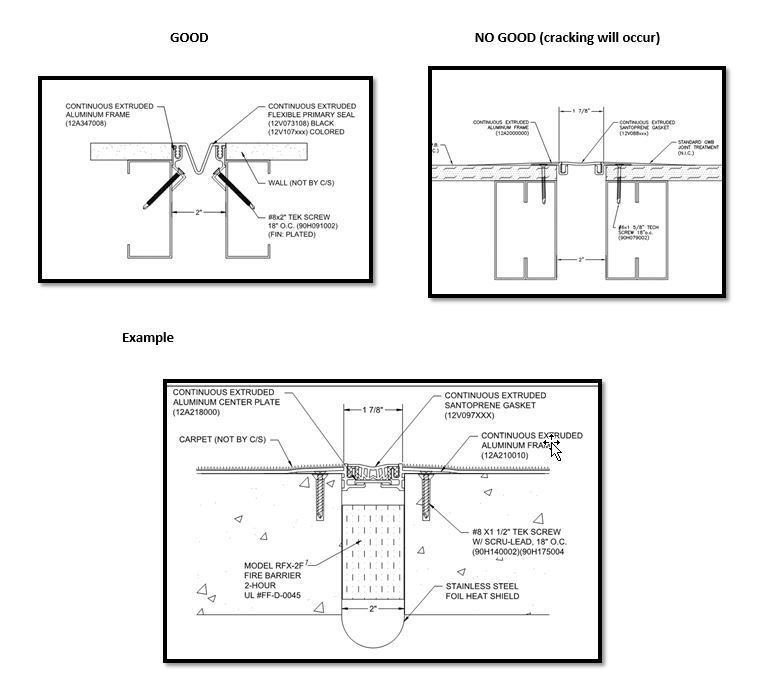
GOOD (Joint is at Finished Surface)

BUILDING EXPANSION JOINTS - FIELD & QC ITEMS
Vertical Expansion Joints Field QC items
- A preconstruction meeting should be held with all parties (KAST, Expansion Joint Applicator, and Exterior Cladding Subcontractor) to review all conditions and means and methods. Manufacturer's representatives should perform periodic and final inspections along with Building Envelope Consultant.
- Confirm the tie-in detailing where the vertical expansion joint ties into the horizontal roofing system, or stucco accessory
- Verify the proper detailing of the entire joint assembly from the structural level out to the finish cladding level.
- Depending on the design parameters of the expansion joint, the expansion joint material (i.e. Tremco DualFlex) is located at the structural level with a finish sealant bead to complete the assembly at the exterior cladding level. NOTE typically polyurethane sealants are high modulus (i.e. rigid), do not hold up to UV, and will NOT work as the finish bead of sealant as they will not handle the movement of the joint. KAST standard is to use a low modulus (i.e. high flexibility) silicone sealant such as Dow 790 or Tremco Spectrum 1 for this type of assembly.
- Confirm proper adhesion of materials, through pull (adhesion) tests conducted by manufacturer prior to full installation of materials.
- Review all vertical to horizontal transitions to ensure monolithic assembly of the waterproofing at these critical transitions.
- Be sure the expansion joint subcontractor field measures the joint prior to ordering the material. The joint will move between the time the concrete or masonry is installed to when the expansion joint material is installed.
- Some products from Emseal or MM Systems are available with a ‘pre-finished’ silicone face. The pre-finished material is subject to damage from other trades due to the sequencing of the work. Additionally, if the joint varies in width, you could end up a different look as you go up the building (e.g. 4 silicone rows in lieu of 3)
- Other products allow field finishing of the silicone face. Tremco Ilmod is a pre-compressed impregnated foam seal that can be field caulked at the proper time to allow for a clean and uniform finish. Tremco Dualflex is an elastomeric SEBS rubber membrane which provides movement capability without compromising the waterproofing.


Horizontal Expansion Joint Field QC items
- A preconstruction meeting should be held with all parties (KAST, Expansion Joint Applicator, and Exterior Cladding Subcontractor) to review all conditions and means and methods. Manufacturer's representatives should perform periodic and final inspections along with Building Envelope Consultant.
- Review sequencing of work around the installed expansion joint to ensure it is not damaged by other trade contractors. If it is installed/designed to occur at the surface level it can be installed AFTER all other trades have completed their work. This is a KAST best practice.
- Ensure proper sequencing of work when installing expansion joint material to ensure ship lap effect
- Review all vertical to horizontal transitions (i.e. waterproofed deck to vertical planter wall, vertical planter wall to horizontal planter top) to ensure monolithic assembly of the waterproofing at these critical transitions.
Interior Expansion Joints
- Review all submittals for proposed interior expansion joint materials. Confirm material will meet the anticipated movement requirements of the joint as specified by the structural engineer.
- Confirm/review fire rating of material/assembly as applicable.
- Confirm finish details with flooring and drywall partitions.
- Many interior horizontal joints require a slab depression (which will never be shown on the drawings), if this is the case, the concrete subcontractor must be bought this way and informed of this requirement. KAST Best Practice is to not use this type of joint. If it has been specified, find an alternative. Many are available from Construction Specialties.
- Be sure expansion joints in drywall partitions allow for movement, see below snap for the recommended product.